Executive Summary
In a world where homelessness affects millions, including vulnerable populations in communities like Owensboro, Kentucky, we have an opportunity to create lasting change. Our proposed Tiny Home Village is a self-sustainable, supportive community designed to provide permanent housing, personalized care, and empowerment for formerly homeless individuals and families. Built on principles of dignity, community, and self-sufficiency, this village will initially house up to 150 residents, including single adults, single parents with children, and small families, in durable, tornado-resistant tiny homes. The modular design allows for quick expansion to add homes as needed, fostering a "no-fail" environment where everyone can thrive.
This innovative model addresses societal gaps by offering stable housing without eviction threats, mandatory therapy and drug testing for wellness, on-site job opportunities, year-round food production, and communal activities that build connections. With a focus on efficiency—leveraging hydroponics, resident labor, monetized content, and integrated solar power—we aim to achieve financial sustainability while transforming lives. Residents can utilize on-site produce, chickens, eggs, and fish for personal meals, with optional use of the communal cafeteria. Initial startup and build costs are estimated at $7.25 million (including solar integration), with annual operations around $2.8 million (reducing to ~$2.61 million post-solar implementation), offset by growing revenues from rent, produce sales, and more.
We seek partners, donors, investors, and collaborators to bring this vision to life. Your support can help end homelessness one community at a time, creating a scalable model for nationwide impact.
The Problem: Homelessness in Our Communities
Homelessness is a crisis driven by systemic failures: lack of affordable housing, mental health challenges, job instability, and insufficient support structures. In Owensboro and Daviess County, Kentucky, rising homelessness affects individuals and families, with a shortage of 3,000-3,800 affordable housing units and chronic cases including those camping unsafely near areas like English Park along the Ohio River. Statewide in Kentucky, approximately 5,789 people experienced homelessness in 2025, up from prior years. Nationally, over 771,000 people experience homelessness on any given night, with costs to society averaging $35,000-$111,000 per chronically homeless person annually in inefficient programs.
Family homelessness is particularly acute, with a 39% increase in families staying in shelters or on the streets in 2024. An estimated 2.5 million children experience homelessness each year (one in every 30 children), and about one-third of homeless individuals (259,473) are in families with children. In Owensboro, shelters like Daniel Pitino (for women, women with children, and families), CrossRoads (for women and children), and My Sister's Keeper highlight the need for family-inclusive housing.
Traditional shelters often provide temporary fixes without addressing root causes, leading to high recidivism rates (up to 50%). People need more than a bed—they require structure, skills, community, and a path to independence. Our village tackles this by offering a humane, efficient alternative that empowers residents, including families, to rebuild their lives.
Our Solution: A Self-Sustainable Tiny Home Village
Located on 8-10 acres of non-flood-prone land just outside Owensboro, our village will be a modular, expandable community emphasizing safety, sustainability, and support. The design allows for rapid addition of homes to accommodate emerging needs, such as for single parents or families. Based on efficient layouts from existing tiny home communities, 100 homes can fit comfortably on 8-10 acres with 40-100 feet spacing between units, leaving ample room for greenhouses (0.5-1 acre), communal areas, and a hybrid solar system (rooftop panels on homes and greenhouses supplemented by a small ground-mounted array of ~0.5-1 acre). This footprint draws from successful examples like off-grid tiny home setups on similar-sized plots with integrated solar. Key elements include:
Durable Housing: A mix of 100 tiny homes, including 70 single-occupancy units (80-120 sq ft), 20 two-bedroom units (200-300 sq ft for single parents with 1-2 children), and 10 three-bedroom units (300-400 sq ft for small families), accommodating up to 150 residents initially. All are built from concrete and rebar for tornado resistance and insulation, with kitchenettes for independent meal preparation. Each features a private bathroom (like a hotel room). 10% modified for disabled residents with ADA-compliant features. Drawing from family-inclusive tiny home villages like those in Kentucky where families have separate spaces for children, this setup promotes privacy and stability.
Food and Sustainability: Year-round produce via greenhouses and hydroponic systems, supplemented by on-site chickens, eggs, and fish (aquaponics integration). This provides nutritious meals, surplus for local sales, and resources for residents' personal use, reducing food costs by 40-60% and creating resident jobs in farming.
Solar Power Integration: A hybrid community-scale solar array (1,000 kW system with battery backups) offsets 100% of electricity needs, reducing utilities from $250,000 to ~$60,000 annually starting Year 2. This promotes energy independence, resilience during outages, and environmental benefits (e.g., ~1,000 tons CO2 reduction yearly), paying for itself in ~9 years.
Empowerment and Work Opportunities: Every resident can work part-time on-site (e.g., cooking, cleaning, maintenance, bus driving, solar upkeep), building skills and resumes. Paid cleaning services for rooms (optional fee for those with income) promote accountability. Interns manage social media to produce monetized content (e.g., tutorials on sustainable living), with residents compensated for contributions.
Support Services: Mandatory therapy, drug testing, and personalized plans to stabilize residents—helping secure SSI (up to $967/month in 2025, with potential COLA increases in 2026) or external jobs. Transportation via two small buses ensures access to Owensboro services.
Community and Rules: A "no-fail" ethos allows indefinite stays for meaningful contributors. Sliding-scale rent (30% of income, utilities included, capped at $1,500/month) starts after stabilization. Optional communal cafeteria, gym, tech room, and activities (e.g., holiday celebrations) foster belonging and fun.
This model draws from successful tiny villages nationwide, including those accommodating families, achieving 50-70% transition rates to independence while being 70-80% more cost-effective than traditional programs.
Impact and Benefits
For Residents: From homelessness to a safe home with no worry about payments. Surrounded by supportive peers, residents—including families—gain structure, skills, and joy—imagining holidays celebrated together, flexible work schedules, and tools to thrive.
For Communities: Reduces street homelessness, lowers public costs (e.g., emergency services), and boosts local economies through produce sales and resident employment. In Owensboro, it directly aids river campers and families, scaling as a regional model.
For Society: A replicable blueprint for addressing homelessness efficiently, promoting self-sustainability, and challenging ineffective systems. Potential for national expansion, starting in Kentucky.
Measurable Outcomes: Target 80% resident retention, 40-60% employed or on benefits within 6 months, and break-even operations by Year 5+.
Financial Overview
Startup and Build Costs (Year 1 Total: $10.05 Million)
Non-Profit Formation: $3,000
Land/Site Prep: $80,000
Tiny Homes: $3.2 million (70 singles at ~$25,000 each; 20 two-bedroom at ~$40,000 each; 10 three-bedroom at ~$60,000 each, including kitchenettes and tornado-resistant features)
Disabled Modifications: $75,000
Greenhouses/Hydroponics/Aquaponics: $750,000
Solar Array and Battery Backups: $2.75 million (net after incentives)
Transportation: $60,000
Other (Permits, AI Monitoring, Amenities): $300,000
Year 1 Operations: $2.8 million
Annual Operating Costs (Years 2-5, with 2.5% Inflation)
Year 2: $2.68 million
Year 3: $2.75 million
Year 4: $2.82 million
Year 5: $2.89 million
Breakdown: Staffing ($900k), Food ($400k), Utilities ($60k post-solar), Maintenance ($150k), Programs ($150k), Misc ($250k). Efficiencies from resident labor, farming, and solar keep costs stable.
Projected Revenue (Years 1-5)
Revenue from rent (sliding-scale, post-stabilization), produce sales, content monetization, cleaning fees, and grants grows steadily:
Year 1: $780,000
Year 2: $1.15 million
Year 3: $1.45 million
Year 4: $1.82 million
Year 5: $2.15 million
Net improves from -$9.27 million (Year 1, including build) to -$0.74 million (Year 5), trending toward surplus.
Expanded Financial Projections for the Tiny Home Village
To determine when the project begins to see a surplus (i.e., when annual revenue exceeds annual operating costs, resulting in a positive net for the year), we've expanded the projections beyond Year 5 using a data-driven approach. Here's how we arrived at this:
Revenue Modeling: The provided revenues for Years 1-5 ($0.78M, $1.15M, $1.45M, $1.82M, $2.15M) show a strong linear trend. Using linear regression, the best-fit line is Revenue = 0.341 × Year + 0.447 (with an R-squared of 0.999, indicating an excellent fit). This assumes steady growth based on the historical pattern, driven by increasing rent collections, produce sales, content monetization, and grants as the village stabilizes and expands.
Operating Costs: Starting from Year 1 ops at $2.8M, costs are reduced by ~$0.19M in savings from solar starting Year 2, with inflation at 2.5% annually thereafter. Build costs ($7.25M) are one-time in Year 1 and not included in ongoing ops.
Net Calculation: Annual Net = Revenue - Ops (excluding the initial build after Year 1). Projections continue until Net > $0.
Assumptions:
No major disruptions (e.g., economic downturns or unexpected costs).
Revenue growth remains linear, reflecting maturation of revenue streams.
Ops inflation stays at 2.5%; efficiencies from resident labor, sustainability, and solar keep base costs stable.
The project achieves full occupancy and program adoption by Year 5, supporting continued growth.
Based on this, the project reaches a surplus in Year 8, with a positive net of $0.07M. Here's the full table, including the original Years 1-5 for context and the extended projections:
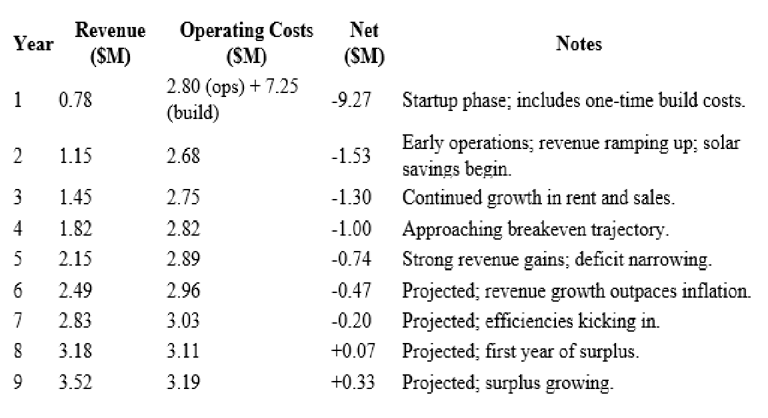
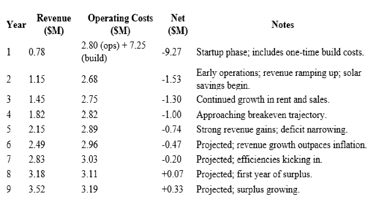
From Year 8 onward, the surplus is expected to grow as revenue continues to increase faster than costs (e.g., Year 9: +$0.33M net, assuming the same trends). This model suggests financial sustainability by the end of the decade.
Sensitivity Analysis
To account for variability, here are scenarios:
Base (as above): Year 8 surplus.
Optimistic (revenue growth +10%, costs +2% inflation): Surplus in Year 7 (+$0.15M).
Pessimistic (revenue growth -10%, costs +3% inflation): Surplus delayed to Year 9 (-$0.05M in Year 8).
Risk Mitigation
Potential risks include incentive changes (e.g., REAP limitations for solar on farmland), occupancy delays, or economic shifts. Mitigation strategies: Secure diverse funding, phase implementation, and maintain flexible expansion plans.
Funding and Partnership Opportunities
We are seeking:
Grants and Donations: From foundations, government programs (e.g., HUD ESG, KY Housing Corporation), and philanthropists.
Corporate Sponsorships: Businesses can fund specific elements (e.g., hydroponics, buses) for branding and tax benefits.
Investments: Social impact investors for low-interest loans or equity in revenue streams.
In-Kind Support: Land donations, materials, or volunteer expertise from local leaders.
Your involvement could range from financial contributions to advisory roles, helping launch this pilot and scale it regionally.
Call to Action
Homelessness isn't inevitable—it's a problem we can solve with compassion and innovation. Join us in building a village that restores hope and dignity for individuals and families alike. Contact Jace Burlbaugh / HGTM at JaceB@HGTM.org / 270-883-2767 to discuss how you can help make this reality. Together, we can create communities where no one is left behind.
Contact
Reach out to support our mission today
Phone
contact@hgtm.org
270-883-2767
© 2025. All rights reserved.